Learning goals
After this chapter you can:
- explain why, with agent code, what counts is not trust in the model but verification of the result.
- use tests as oracles and recognise when a green test run proves nothing.
- distinguish build gate, quality gate and human approval and combine them sensibly.
- justify the principles “read-only reviewer” and “fail closed”.
- tell a correction loop apart from a blind retry.
- in the factory, understand and configure the branch per build run, pull requests, the quality gate with its modes, the two approval points and PR/CI feedback.
6.1 Verification, not trust
A language model produces plausible text. Plausible means: the code looks like code that could stand in this place. Whether it is correct is another question. In Chapter 1 you learned about hallucinations: invented methods, wrong assumptions about a library, a test that supposedly passes but was never run. An agent can find some of these errors itself, because it has tools and can call the compiler and tests. But it can also overlook them, explain them away or “fix” them by adapting the test to the wrong code.
This leads to the most important principle of this chapter:
You don't check whether you trust the agent. You check whether the result meets the criteria.
That sounds obvious, but it shifts the work. In classic development, review is often the smaller part: you trust the colleague who wrote the code and look at the tricky spots. With agents the ratio flips. Writing has become cheap; verifying remains expensive. If you don't automate and structure verification, you drown in diffs or eventually wave them through unread.
Three levels of verification
It helps to split verification into three levels that answer different questions:
| Level | Question | Typical means |
|---|---|---|
| Machine, deterministic | Does it build, do the tests pass, does it violate hard rules? | Compiler, unit and integration tests, linters, architecture tests, dependency scan |
| Machine, judgement-based | Does the code look reasonable, are there obvious errors or risks? | Static analysis with heuristics, LLM reviewers, hallucination check |
| Human | Is this what we wanted, and do we take responsibility for it? | Diff review, approval, acceptance against acceptance criteria |
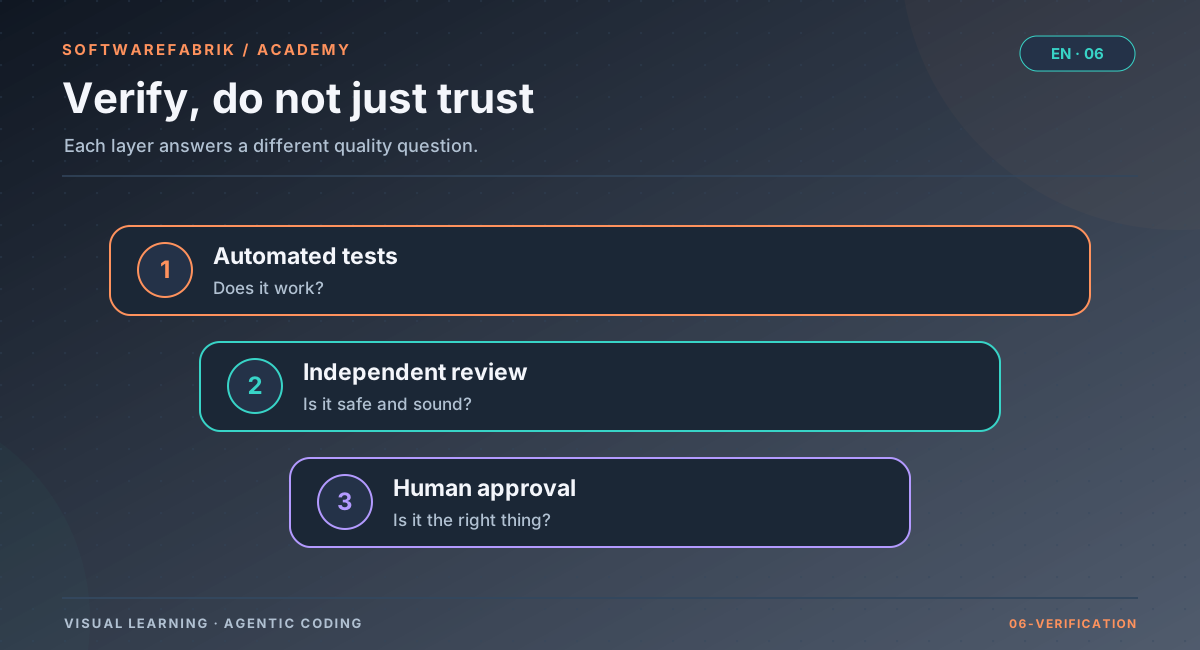
No level replaces the others. Deterministic checks are reliable but only see what someone formulated as a rule or test beforehand. Judgement-based checks also find the unplanned, but are occasionally wrong. The human carries the responsibility but has limited attention. Good pipelines put the cheap, reliable checks first, so that expensive human attention is only needed for what machines cannot decide.
Good is not the same as right
One distinction will accompany you throughout the course: code can be good (clean, secure, well structured) and still do the wrong thing. Most automated checks answer the first question. The second requires a yardstick outside the code: acceptance criteria. How to write them is covered in detail in Chapter 4. Here the topic is how to feed them into verification.
6.2 Tests as oracles
In testing theory, the authority that decides whether a result is correct is called the oracle. For coding agents, automated tests are the most important oracle because they combine three properties: they are executable, repeatable and independent of the agent's self-report.
What makes a test a good oracle
- It checks behaviour, not implementation. A test that only checks that a particular private method was called breaks with every refactoring and proves little about behaviour.
- It can fail. A test that would also be green with wrong code is no oracle. The check: would it turn red if you commented out the core logic?
- It covers negative and edge cases. Agents prefer to write the “happy path”. The interesting bugs lie in empty input, maximum values, missing permissions and concurrent access.
- It can be traced back to a requirement. If a test carries an acceptance criterion ID, you know which requirement it proves and can see which requirement has no test yet.
Typical deceptions
Agents optimise for what you visibly check. If the only check is “tests are green”, there are several ways to get there that you don't want:
- A failing test gets deleted, commented out or given an ignore annotation.
- The expected values in the test are adapted to the wrong result.
- The agent claims in its final report that “all tests pass” without anything having changed in the tests or without them having run at all.
- The new code isn't reached by any test at all, yet the suite is green.
Two things help against this: first, you let the pipeline run the tests instead of having the agent report on them. Second, in reviews you look specifically at changes to test files. A diff that changes production code and expected test values at the same time deserves a second look.
Test first, for agents too
A proven way of working: first write the test that describes the desired behaviour and fails today, then implement until it turns green. For agents this is particularly effective because the red test sets an objective goal. For bug fixes, correspondingly: first a test that reproduces the bug. The factory's engineering guardrails require exactly this (guardrail “Make it verifiable”): translate the task into verifiable success criteria and ship the reproducing test so that the gate can enforce it.
// Bug-fix assignment: "Discount becomes negative at order value 0"
@Test
void rabattBeiWarenwertNullIstNull() {
    var kasse = new Kasse(Rabattstaffel.STANDARD);
    assertThat(kasse.rabattFuer(Betrag.euro(0))).isEqualTo(Betrag.euro(0));
}
// First red (reproduces the bug), then green (proves the fix).In the factory
A branch per build run and a persistent workspace
Verification requires a clearly delimited state that you can verify. The factory ensures this through Git discipline:
- The workspace belongs to the project, not the run. Under
<workspaces-root>/<projekt-slug>/there is a Git repo on which every follow-up run continues. Run 2 sees the code of run 1. - Every build run works on its own branch
sdlc/run-<id8>. On success it is merged into the base branch or a pull request is opened; on failure the work stays on the run branch for inspection, and the base branch stays clean. - One run per workspace at a time. Only one run is active per project at any time (concurrency guard); different projects run in parallel. Parallelism within a project exists only via the workflow layer from Chapter 7.
- Repository reality. Before each build run, the base branch is fast-forwarded to the remote state. A merge conflict does not abort the run; instead it enters the correction loop with the conflicting files as a work instruction.
- Checkpoints. At start, the factory creates or opens the workspace, writes the Markdown artefacts and commits them as a checkpoint. The inline diff in the approval view shows the changes since the earliest checkpoint (up to 256 KB).
6.3 Build gates: the first, cheapest hurdle
A gate is a checkpoint that a result has to pass before it moves on. The simplest and most important gate is the full build with all tests. It answers the question “Is this state internally consistent?” deterministically and without room for interpretation.
What belongs in a build depends on the stack. Typical are:
- compilation or type checking,
- unit and integration tests,
- architecture tests (for example layering rules with ArchUnit),
- linters and format checks,
- coverage thresholds,
- dependency and licence checks.
The more of this the build contains, the more errors the cheapest verification stage catches. This has a pleasant side effect: on a red build, the agent gets back a concrete, machine-readable error message that it can use to make targeted fixes. “The reviewer didn't like it” is harder to act on than “Test rabattBeiWarenwertNullIstNull expected 0, got -5”.
The build must run from the outside
An agent can and should build and test on its own while working. But the result of that self-test is a self-report. The gate therefore runs once more, outside the agent session, in an environment the agent has not modified. Only this run counts.
In the factory
VALIDATION and the automatic correction loop
In the run lifecycle (INTAKE → PROMPT_ASSEMBLY → WORKSPACE_PREPARATION → EXECUTION → VALIDATION → CORRECTION → COMPLETION), VALIDATION is the build gate. The run is then in status VALIDATING.
- What is checked: Validation currently runs
mvn verify. It is therefore Java-centric; without apom.xmlin the workspace it is skipped. For other stacks, the quality gate (see below) provides the content check. - Container sandbox: With
execution.sandbox.variant = container, the build and scans run in an ephemeral container with--network=none, limited resources and write access only to the workspace. The agent itself runs as a host process; details in Chapter 8. - Red build: The run moves to
NEEDS_CORRECTION. The factory automatically feeds the build feedback into another run on the same branch (NEEDS_CORRECTION → RUNNING), with at most two correction runs per run in total. After that the run stays inNEEDS_CORRECTION, and you decide. - Green build: On to the quality gate (if active), to the approval before merge (if required by an approval policy) and finally to merge or pull request.
6.4 Code review by human and machine
A green build tells you that nothing known is broken. It says nothing about things for which there is no test: an SQL query built by string concatenation, an API key in the source code, a class in the wrong layer, an invented method that happens to sit in a branch that never executes. That is what reviews are for.
Machine reviewers
Machine reviewers come in two kinds:
- Static, rule-based reviewers search the diff for known patterns: hard-coded keys, path traversal, layering violations, modified database migrations. They are fast, cheap and reproducible, but only see what there is a rule for.
- LLM-based reviewers read the diff like a human and comment on logic errors, unclear names or missing edge cases. They find the unforeseen, but are themselves a language model with all its weaknesses. They are therefore used with a confidence score and are not allowed to decide on their own.
Independence: whoever writes does not approve
A central principle is independent verification: the agent that wrote a change must not approve it itself. It is the same logic as the four-eyes principle among humans. An agent assessing its own work tends to confirm its own assumptions. A separate reviewer with a different assignment (and ideally a different context or model) sees different things.
Reviewers don't write
This leads to a second rule: reviewers are read-only. A reviewer who “quickly” fixes a bug is no longer a reviewer but a second author whose changes nobody has checked. Moreover, a manipulated or faulty reviewer could otherwise alter the object under review while reviewing it. Findings therefore go back to the author as structured feedback, never as changes in the workspace.
The human in the review
Machine reviews relieve the human but do not replace them. Good human reviews of agent code focus on:
- Does the diff match the assignment, or did the agent do more (or something else)?
- Were tests changed, and if so, why?
- Are there changes outside the expected area (build files, configuration, migrations)?
- Did the agent disclose assumptions or deviations (in the decision log, in the code or under
plans/)? The PR text itself comes from the factory and only refers to them.
The last point is no accident: the guardrails require the agent to make assumptions and deliberate deviations visible instead of asking questions that nobody answers during an autonomous run. A review should read these spots first.
In the factory
The quality gate and its six reviewers
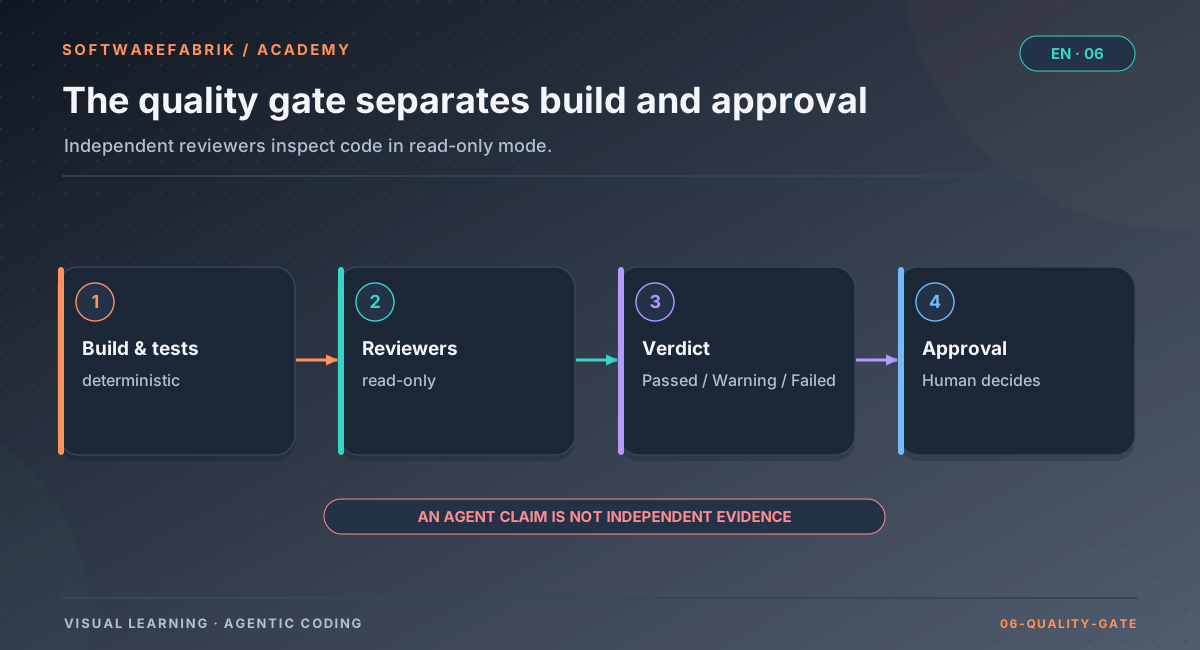
In addition to the build gate there is the quality gate, reachable via /runs/{id}/quality-gate. Since v0.14 it runs as part of the run pipeline after a successful build and can additionally be triggered manually on the run detail page. It calls six read-only reviewers:
| Reviewer | Kind | Checks |
|---|---|---|
claude-review | LLM (read-only) | Diff review by Claude Code |
aider-review | LLM (read-only) | Diff review by Aider |
security-reviewer | static | hard-coded keys, path traversal, SQL concatenation, Runtime.exec, password logging |
architecture-reviewer | static | layering violations, JPA in the domain, changes to existing Flyway migrations (CRITICAL) |
hallucination-reviewer | static | invented classes/methods, TODO markers, “tests pass” without test changes |
dependency-scan | Trivy | CVEs and licence violations in dependencies |
The findings are aggregated into a verdict: PASSED, WARNING, FAILED, SKIPPED or ERROR.
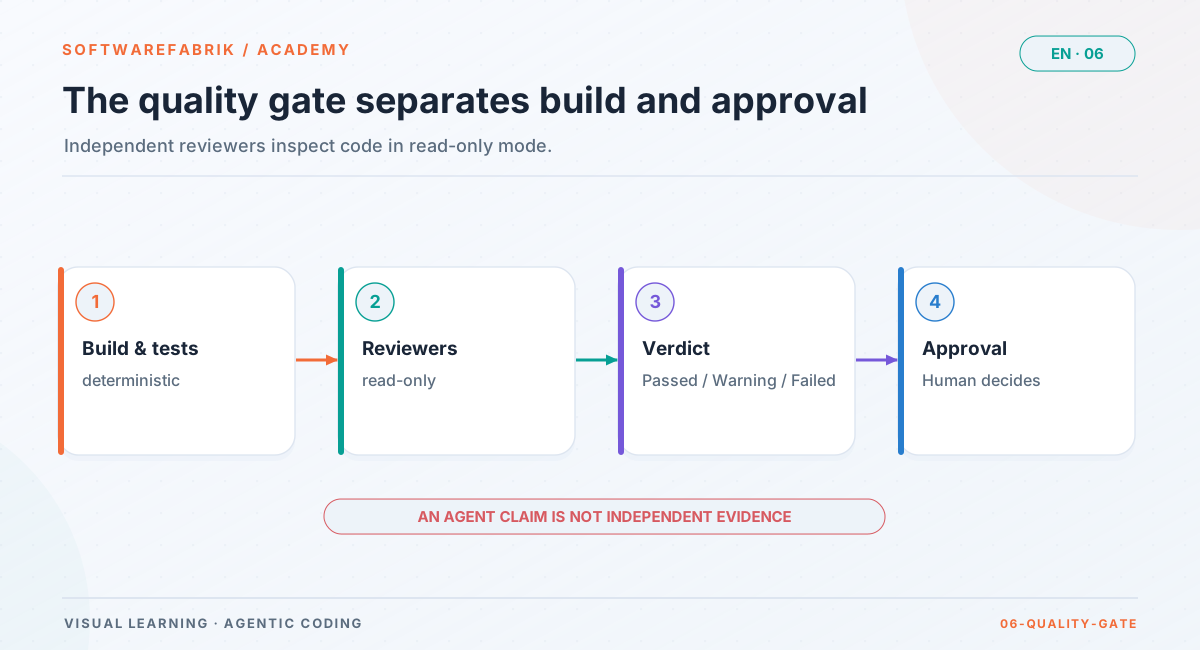
Open full-size graphicOpen full-size graphic
SKIPPED or ERROR, and approval before merge only applies with an approval policy (see “Two approval points” below).Technically read-only
The Claude Code review is restricted to reading not only by its assignment but technically: it runs with --permission-mode dontAsk and --disallowedTools for Edit, Write and Bash. The Aider review, by contrast, is read-only only by assignment, because Aider has no binding read-only flag. By default, the review model is a smaller, cheaper model (softwarefabrik.review.claudecode.model), see Chapter 10.
Policies and rules that always apply
strictblocks CRITICAL and HIGH, requires the categories SECURITY and ARCHITECTURE and sets a confidence threshold of 0.70.lenientblocks only CRITICAL.- Regardless of the policy, the following always cause the gate to fail: SECURITY/HIGH and SECURITY/CRITICAL, ARCHITECTURE/CRITICAL. This blocks in mode
blocking; in the defaultadvisorythese findings are displayed. A reviewer that fails technically (timeout, exit code, unreadable output) results inERROR, never in a silent pass. If its CLI is not installed at all, it reportsSKIPPED; that is notPASSED, but only blocks if the policy requires the category or reviewer (strict).
You set the policy via run.quality-gate.policy.
Operating mode
Mode (run.quality-gate.mode) | Effect |
|---|---|
off | Reviewers don't run. |
advisory (default) | Findings are collected and displayed but don't block. |
blocking | FAILED or ERROR produces feedback and starts the correction loop. |
You set the mode under Settings; tenant-wide, policy-as-code (field gateModus) can override it. The compliance profiles EU AI Act, BAIT/MaRisk/DORA and BSI/VS-NfD set it to blocking (Chapter 9).
advisory, follow the findings for a few runs and learn which reviewers are useful in your project and which are noise. Then switch to blocking. A gate that constantly blocks for no reason gets bypassed; a gate that never blocks gets ignored.
6.5 Fail closed: when the check itself fails
Any verification infrastructure can fail: a scanner is missing from the path, an LLM reviewer gets no response, a configuration file is unreadable. The decisive question is what happens then. There are two options:
- Fail open: The check is skipped and the result counts as passed. That is convenient and dangerous, because an attacker or a configuration error only has to make the check crash.
- Fail closed: A check that could not take place does not count as passed. The result is held until someone clarifies the cause.
For anything concerning security or evidence, fail closed is the only defensible stance. The factory's parallel roadmap formulates this as architecture principle AP-7: a failed mandatory reviewer, a policy that cannot be checked or a failed attestation must never count as success.
Fail closed comes at a cost: occasionally a run stops because a tool is missing, even though the code would be fine. That is the price for a green result meaning something. And there is an honest alternative to silent circumvention: if you deliberately don't want a reviewer, you switch it off, visibly and traceably, instead of letting it fail.
ERROR, a reviewer has failed technically (timeout, exit code, unreadable output). That is deliberately not a silent pass. If a reviewer's CLI is missing entirely, it appears as SKIPPED; the strict policy requires the categories SECURITY and ARCHITECTURE, so that missing pieces there don't go unnoticed.
6.6 Correction loops: new information instead of blind repetition
When a gate fails, it is tempting to simply run the agent again. Language models are not deterministic; maybe it works the second time. That is exactly a bad idea, for three reasons:
- It costs tokens and time without specifically increasing the probability of success. The agent has the same information as before and will very likely make a similar mistake.
- It obscures causes. A run that turned green “on the third try” may be green by chance, for example because a flaky test happened to pass this time.
- It invites optimising for the gate. The more often you repeat, the greater the chance that some run passes the gate in an undesired way.
A sensible correction loop therefore only repeats when new information is available: compiler output, a failed test with its message, a reviewer finding, a merge conflict with the affected files, a red CI result. This information goes into the next run as a work instruction. The parallel roadmap calls this AP-6: Rule Loop instead of Blind Retry.
Set limits
Even an informed loop needs an upper limit. If two targeted correction attempts are not enough, the cause is usually not a trifle but a misunderstanding in the assignment, missing context or a contradiction in the requirements. Then a human needs to take a look, not a third run.
Good correction input
- Concrete: error message, file, line, affected test.
- Complete but filtered: the relevant excerpt of a log, not ten thousand lines.
- With a goal: “Fix the bug without changing the test expectation” is better than “make it green”.
In the factory
Where the correction input comes from
The factory starts the correction loop only for concrete reasons, and each reason brings its own information:
| Trigger | Input for the next run | Limit |
|---|---|---|
Red build in VALIDATION | Build feedback | shared counter: at most 2 correction runs per run in total, then NEEDS_CORRECTION |
Quality gate FAILED/ERROR in mode blocking | Feedback from the findings | as above |
| Merge conflict when merging into the base branch | Conflicting files as a work instruction | as above, then resolve manually |
| Red CI in the pull request (PR feedback active) | CI result | as above |
All correction runs continue on the same run branch. If a run doesn't reach a green state after the attempts, the work stays on the branch, the base branch is untouched, and you decide: sharpen the objective and start a new run, add context (for example in the project memory) or decompose the assignment.
6.7 Placing human approvals correctly
A human who has to confirm every intermediate step becomes a bottleneck and at some point clicks reflexively. A human who is never asked carries responsibility for something they haven't seen. The art lies in placing approvals where a decision actually changes something.
Two points have proven themselves:
- Before execution: May this assignment run at all, with this agent, this model and this budget? Here you prevent expensive or risky runs before they produce costs or changes.
- Before adoption: Is the validated result good enough to go into the main line? Here you decide with full knowledge: diff, build result, gate findings.
The second approval is the more important one when it comes to responsibility. An approval that only happens after the code is already on the main branch is a façade.
Segregation of duties
In regulated environments, segregation of duties applies in addition: whoever triggered a change must not approve it themselves. That is the human counterpart to “whoever writes does not approve”.
In the factory
Two approval points and segregation of duties
The factory has two approval points per build run:
| Point | Effect | Control |
|---|---|---|
before EXECUTION | The agent only runs after approval. | Without an active approval policy, the default run.approval-vor-merge (on; false switches it off); otherwise the approval policy under /policies or the mandatory approval phases in policy-as-code |
before the merge (in VALIDATION) | The validated state is only merged or opened as a PR after approval. | Only via an approval policy under /policies or pflichtFreigabePhasen including VALIDATION (e.g. in the BAIT/MaRisk/DORA and BSI/VS-NfD profiles) |
- A run waiting for approval is in
WAITING_FOR_APPROVAL. On the run detail page you see the inline diff and approve via “Approve and continue”. The diff is meaningful mainly for the approval before merge; before execution it contains only the factory's artefacts. - Approving requires role
MAINTAINERor higher. Withrun.approval-segregation, whoever triggered the run (run.triggered_by) may not approve it themselves. - Every decision is recorded as an
approval_decisionand as an attested audit event. In the why-trace (/runs/{id}/trace) you can later see who approved when. - Optionally, the approval form records a voluntary self-reported “effort (minutes)”, which feeds into the metrics.
WAITING_FOR_APPROVAL? Then a mandatory approval is active. Check who may approve (MAINTAINER or higher) and whether segregation of duties excludes the person who triggered the run.
6.8 Pull requests and CI as a second verification authority
In many teams, the pull request is where code is reviewed and adopted: CI builds and tests, colleagues comment, branch rules enforce green checks before merging. Agentic development should fit into this flow instead of working around it. That has several advantages:
- The target repo's CI is a second, independent check. It runs in a different environment, often with additional tests, and knows nothing about the agent.
- Existing rules (protected branches, mandatory reviews) automatically apply to agent code too.
- The history stays in one place: anyone who later asks why a change was made finds it in the PR with description and discussion.
Feedback is what matters: if CI turns red after the agent has finished, that information must go back into a correction loop. Otherwise a red PR is left lying around and someone has to fix it manually.
In the factory
Setting up pull requests and PR/CI feedback
- Set the Git remote URL on the project (project page, remote URL form).
- Store a GitHub token under
/integrations. Keys are stored there AES-GCM-encrypted and validated against the provider. - Check the allowlist: The factory uses the token only for hosts listed in
SOFTWAREFABRIK_GIT_ALLOWED_HOSTS. This way a manipulated remote URL cannot capture the token (details in Chapter 8). - From now on, a successful build run pushes its branch and opens a pull request; the merge happens via the PR. Without a remote and token, the local merge applies.
- Optional: PR/CI feedback — enable it with
git.pr-feedback.enabled(off by default). The run then waits in stateWAITING_FOR_PRfor green CI and a merge; red CI starts a correction.
In spec mode (Chapter 4), the factory commit and the PR body carry the trailers Spec: SPEC-<nnn> and Implements: AC-…. Reviewers in the PR thus see immediately which acceptance criteria the change is meant to implement.
WAITING_FOR_PR, the PR has not been merged yet or CI is not green.
6.9 From “good” to “right”: acceptance criteria in the gate
All the checks mentioned so far mostly answer the question of whether code is good. To check whether it does the right thing, the gate needs a domain yardstick. Two building blocks make this possible:
- Acceptance criteria with stable IDs, supplied with the assignment. A reviewer can then ask specifically: is AC-007-03 fulfilled by the diff?
- Tests that reference these IDs (in the name, as an annotation or in a comment). This makes coverage measurable: for which criteria is there at least one test, and for which not?
Conversely, you can also ask: which changes in the diff belong to no criterion? Such uncovered behaviour is not automatically wrong, but it hints at scope creep or a forgotten criterion.
In the factory
Acceptance criteria reach the reviewers
- Since v0.35: When a build run starts from a backlog item with a spec reference (spec mode
LEICHT(light) orSTRENG(strict)), the factory passes the acceptance criteria (ID and text) of the approved spec version to all reviewers inReviewRequest.acceptanceCriteria. Before that, this field was always empty. - Since v0.36: The same run also receives the bound criteria in the objective header, identically for every execution adapter, and the bound version is attested as
RUN_SPEC_GEBUNDEN. - Since v0.38.0 (SPEC-003): A rule-based reviewer
spec-conformance(categoryREQUIREMENTS, without an agent CLI) reports, for runs with a bound spec version, every bound criterion that is not referenced in any test, points out tests with unknown AC IDs and lists changed production files without an AC assignment as “uncovered behaviour”. In modeSTRENGit is a mandatory reviewer, missing coverage isCRITICAL, and the gate runs in blocking mode, even if the global gate mode isadvisoryoroff; in modeLEICHTits findings are advisory.
How to phrase criteria so that good tests follow from them, and how coverage works in detail, is covered in Chapter 4.
6.10 Summary: the verification chain of a build run
Assignment (objective, acceptance criteria if any)
   │
   ├─ Approval before EXECUTION (default without policy: run.approval-vor-merge)
   ▼
EXECUTION on branch sdlc/run-<id8>
   ▼
VALIDATION: mvn verify ──red──► correction loop (build feedback, ≤ 2)
   ▼ green
Quality gate: 6 read-only reviewers
   │   advisory: display   blocking: FAILED/ERROR ──► correction loop
   ▼
Approval before merge (approval policy / pflichtFreigabePhasen=VALIDATION)
   ▼
Merge into base   or   push + pull request
                          ▼ (git.pr-feedback.enabled)
                       WAITING_FOR_PR: red CI ──► correction loop
                          ▼ green + merged
COMPLETED- Verify results, not intentions. An agent's self-report is not verification.
- Put cheap, deterministic checks first and make them as strict as possible.
- Reviewers are independent and read-only; whoever writes does not approve.
- Fail closed: a check that failed to run is not a success.
- Repeat only with new information, and limit the attempts.
- Place human approvals where they decide something, above all before adoption.
Exercise
Exercise: Design a verification chain for a project
Take a project of your own or the “phone book API” example from the tutorial.
- Build gate: List what a full build in this project should check. Which checks are missing today that would catch agent errors early (architecture tests, coverage, linters)?
- Gate mode: Decide which
run.quality-gate.modeand which policy (strict/lenient) you start with, and by what criterion you switch toblocking. - Approvals: Decide whether you keep the default approval before execution (
run.approval-vor-merge), whether you require an approval before merge via an approval policy, and whether you needrun.approval-segregation. Justify in two sentences. - Hands-on with the mock: Set the adapter to
mock, create a build run and follow the phases up toCOMPLETEDon the run detail page; resolve the stop inWAITING_FOR_APPROVALbefore execution with “Approve and continue”. Then open/runs/{id}/quality-gateand the why-trace/runs/{id}/traceand note which information you find where. - Review checklist: Write a five-point checklist that you tick off for every agent diff before approval.
Solution sketch
A sensible start: build with tests, ArchUnit and a coverage threshold; gate on advisory with strict, switching to blocking after about ten runs without unfounded findings. The default approval before execution stays on; in a team, additionally an approval policy with approval before merge, and for regulated projects segregation of duties. Checklist: diff matches the objective; test changes justified; no changes to build files, migrations or configuration without being asked; the agent's disclosed assumptions read; gate findings with HIGH/CRITICAL resolved.
Chapter questions
-
Why isn't it enough for an agent to write in its final report that all tests are green?
Model answer
The report is a self-report. The agent may be wrong, or may not have run, may have changed or deleted tests. Only a build and test run executed by the pipeline outside the agent session may count. The factory's
hallucination-reviewerlooks for exactly the pattern “tests pass” without test changes. -
What distinguishes a good test as an oracle from a bad one? Name three characteristics.
Model answer
It checks behaviour rather than implementation, it can actually fail (would be red with wrong code), it covers negative and edge cases, and it can be traced back to a requirement, ideally via an AC ID.
-
Explain the difference between fail open and fail closed using the example of a reviewer whose CLI is missing.
Model answer
Fail open would skip the missing reviewer and count the gate as passed. Fail closed counts the failed check as not passed. The factory distinguishes: a reviewer that fails technically yields
ERROR, never a silent pass, and in modeblockingthis starts the correction loop. A missing CLI yieldsSKIPPED; that is explicitly notPASSED, and thestrictpolicy requires the mandatory categories, so that the absence doesn't slip through silently. -
Why are the factory's reviewers read-only, and how is this enforced technically for the LLM reviewers?
Model answer
A writing reviewer would be a second, unchecked author and could alter the object under review during the review. Findings therefore go to the author as feedback. Technically, the Claude Code review runs with
--permission-mode dontAskand--disallowedToolsfor Edit, Write and Bash. -
A build run has failed twice in the correction loop and is in
NEEDS_CORRECTION. What do you do, and what don't you do?Model answer
Don't simply restart it hoping for luck. Instead, look at the run branch and the error messages, classify the cause (unclear objective, missing context, contradictory requirement, oversized assignment) and act specifically: sharpen the objective, add context or memory, decompose the assignment, and then start a new run. The base branch is untouched, so there is no rush.
-
Which two approval points does the factory have, and why is the second one decisive for regulated environments?
Model answer
Before
EXECUTION(the agent only runs after approval; without an approval policy, the default viarun.approval-vor-merge) and before the merge inVALIDATION(via an approval policy orpflichtFreigabePhasen). Without the second point, the code would already be on the base branch before anyone approved; the approval would then be a façade. -
Your team wants agent PRs to go through the existing CI as well and to be fixed automatically when CI is red. What do you set up in the factory?
Model answer
The Git remote URL on the project, a GitHub token under
/integrations, the host in the allowlist (SOFTWAREFABRIK_GIT_ALLOWED_HOSTS), and enablegit.pr-feedback.enabled. A successful build run then opens a PR, waits inWAITING_FOR_PRfor green CI and a merge, and red CI starts a correction. Today this only works with GitHub. -
When is
advisorythe better gate mode thanblocking, and when is it the other way round?Model answer
advisoryfits during the introduction phase or for reviewers whose noise you don't know yet: findings become visible but don't block.blockingfits once the findings are reliable, and is mandated for regulated profiles so that aFAILEDorERRORactually forces a correction. -
Transfer: A gate checks whether code is good. What is missing to check whether it does the right thing, and how does the factory close this gap?
Model answer
A domain yardstick: acceptance criteria with IDs and tests that reference these IDs. Since v0.35 the factory passes the criteria of the approved spec to all reviewers, and since v0.36 to the agent in the objective header. Since v0.38.0, the
spec-conformancereviewer checks, rule-based, whether every bound criterion is backed by at least one test and which changes are not assigned to any criterion.